The Stoneridge Tavern Riot
The Ballad of the Last DragonThe Stoneridge Tavern Riot begins as an act of ethnic intimidation and ends as a communal defense of Sylvaine Abelan. A patron’s contempt for her performance gives way to physical coercion and the slur “knife-ear,” but Jaromir, Neith, Cadoc, and the dwarven merchants refuse to let the insult remain private or unanswered. The resulting fight exposes the bodily cost of anti-elven prejudice, the persistence of Sylvaine’s earlier panic, and the uncertain line between protection, retaliation, and uncontrolled violence.
Causes and Background
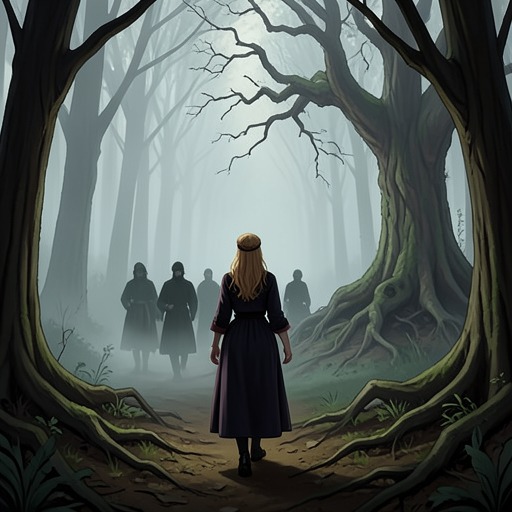
Sylvaine’s vulnerability is established before the confrontation begins. As an elven performer in Tarrgein, she normally keeps her pointed ears hidden beneath a velvet cap because visible signs of her heritage attract prejudice. She has learned that audiences show greater appreciation when her ears remain concealed, and she connects that response to superstition about the ancient elves and to the belief that an elf might use “evil she-elf magic to bewitch them.” Her cap is both costume and concealment: a red crushed-velvet accessory with a large black plume, beautiful enough to support her stage identity but also useful as protection against hostile attention.
That pressure is not merely social. When one of the tavern patrons grips Sylvaine’s upper arm, she recognizes that his anger is unrelated to the quality of her performance. Her muscles freeze, fear closes around her chest, and the contact awakens the kind of anger she has spent her life fearing. The scene therefore shifts from a dispute over service or entertainment to a threat directed at her body and identity. Her attempt to keep the man from knowing how deeply he frightens her shows how prejudice disciplines her behavior even before violence begins.
The tavern’s ordinary atmosphere also contains a material explanation for the eruption. The barkeep later tells Cadoc that the same group has been causing trouble for months and had effectively been asking for someone to intervene. The riot is thus not an isolated misunderstanding created solely by Sylvaine’s presence; it is the visible culmination of repeated misconduct tolerated within the tavern. The setting already contains an unresolved conflict between the patrons’ sense of entitlement and everyone else’s expectation of safety.
What Happens
The immediate confrontation starts when Sylvaine is seized after approaching the group. The man yanks her hard enough to make her shoulder twinge, then tells her to fetch drinks and declares that she is lucky to have been admitted to the tavern at all. His threat to show her what her kind deserves makes the ethnic dimension explicit. Sylvaine has a retort ready, but panic interrupts her: her throat tightens, her chest turns cold, her legs become numb, and her head spins as she fears another attack of panic.
Jaromir breaks the stalemate with a direct command: “Get your fucking hands off her.” He steps between Sylvaine and the aggressor slowly and deliberately, his calm carrying an unmistakable threat. The man retreats for a moment, but the danger intensifies when he continues speaking. Jaromir asks whether the man has called Sylvaine a particular name, then seizes him by the throat when the man appears confused and refuses to recognize the seriousness of his abuse.
Sylvaine tries to stop Jaromir, insisting that the aggressor is not worth the consequences and asking that they leave. Neith places a hand on Jaromir’s shoulder and attempts to create an exit through apology and peace. The aggressor answers by threatening Sylvaine’s “little rabbit ears,” making the body part she has spent the evening hiding into the focus of his violence. Neith responds immediately by punching him in the throat, tackling him, and striking his already bloodied face.
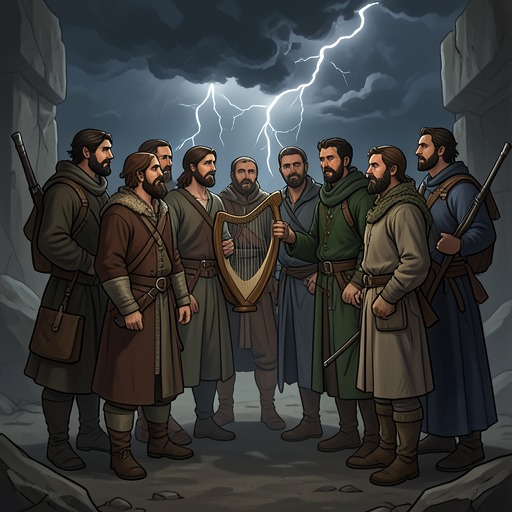
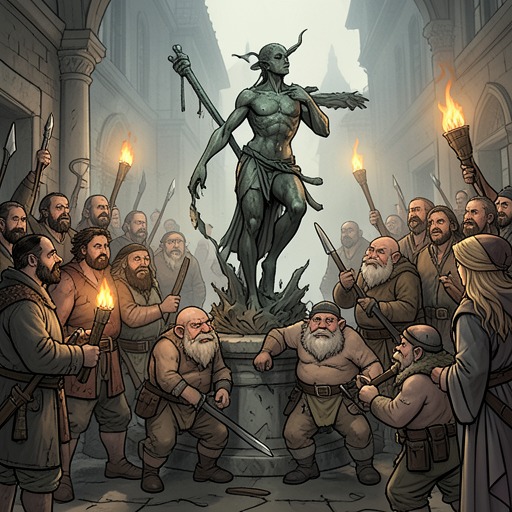
The conflict expands across the room. When the man’s companions move against Neith, Jaromir blocks them and lands a punch that sends a tooth flying. The dwarven merchants who had been sitting with Neith join the fight, throwing bottles and tankards at anyone attacking her flank. Cadoc arrives with a wooden club and beats back stragglers. Furniture breaks, glass crunches beneath boots, and the tavern fills with splinters, pain, and overlapping battle cries. What began with one hand clamped around Sylvaine’s arm becomes a collective melee in which the group’s solidarity is expressed through physical defense.
Cadoc eventually pulls Neith away and leads her out, throwing both his club and a full coin purse toward the barkeep as he passes. The barkeep catches them and acknowledges the payment with a nod. Jaromir remains long enough to grip the original aggressor by the hair, whisper something to him, and strike his bloodied face once more. He then puts an arm around Sylvaine’s shoulders and guides her through the wreckage, helping her avoid overturned chairs, broken glass, and splintered wood as the tavern’s voices recede into an angry ringing.
Participants and Protective Solidarity
Jaromir’s role is defined by controlled intervention that repeatedly threatens to become personal retaliation. He first separates Sylvaine from the man, then takes the aggressor by the throat, restrains the man’s companions, and delivers a final blow before escorting Sylvaine away. His violence is not detached from affection: after the riot, he tucks a strand of hair behind her pointed ear and promises that he cannot erase her past or whatever she has endured, but he will not allow anyone to treat her in that way.
Neith’s defense is more openly explosive. Her attempted appeal to peace lasts only until the aggressor threatens Sylvaine’s ears, after which she attacks with repeated blows and must be physically pulled away. Her fury continues after the immediate danger has been neutralized, showing how the insult has transformed an individual confrontation into an offense against the group’s shared loyalties. Cadoc functions as both combatant and practical organizer: he uses the club to repel attackers, removes Neith from the fight, pays the barkeep, and explains that the tavern staff did not regard the adventurers as the offending party.
The dwarven merchants provide the riot with its clearest image of collective action. They are not passive witnesses or hired protectors; they leap into the fight when Neith is attacked and use the tavern’s bottles and tankards to defend her flank. Their intervention broadens the meaning of the scene. The response to anti-elven violence is not limited to the members of Sylvaine’s traveling party, but becomes a temporary alliance among people who recognize that unchecked aggression threatens the whole room.
Consequences and Aftermath
The riot gives physical form to a conflict that had previously appeared in smaller gestures: Sylvaine hiding her ears, anticipating hostile reactions, and trying to maintain confidence while performing. The insult does not create her fear; it activates a history already lodged in her body. After the group leaves, she is close to hysteria and must take calming breaths while anchoring herself to the immediate fact that she is safe and not alone.
The companions’ reassurance turns the aftermath into more than a simple victory. Jaromir says that neither he nor Neith will permit such treatment, and Cadoc adds his own assurance. Yet Cadoc also acknowledges that the outcome cannot automatically become a model for every future incident. The group needs an agreement about how to respond to this kind of danger, because the tavern’s payment and the barkeep’s acceptance have only resolved the immediate practical consequences. The promise that it will not be the last such occurrence keeps the scene open-ended: the riot is a defense, but it does not remove the social conditions that produced the attack.
The later tavern chatter confirms that prejudice remains embedded in everyday speech. A patron remarks, “I thought elves were supposed to be pretty,” reducing elves to an appearance-based expectation rather than treating them as people. The comment is less immediately violent than the riot, but it belongs to the same continuum of othering. The fight may have protected Sylvaine for one night; it has not made the surrounding culture safe.
Narrative Significance
The Stoneridge Tavern Riot marks a decisive value shift from threatened dignity to defended belonging. Sylvaine enters the confrontation as someone trying to survive economically by making her elven identity less visible. She leaves under Jaromir’s protection, accompanied by companions whose actions declare that her safety is their concern. The scene’s central movement is therefore not simply from calm to violence, but from forced concealment to public solidarity.
Its brutality also complicates the idea of heroic protection. Jaromir’s intervention prevents the aggressor from continuing to control Sylvaine, yet his grip around the man’s throat and final punch show how quickly defense can become vengeance. Neith’s rage makes the same tension unmistakable. The narrative does not present prejudice as an abstract social problem; it shows how an insult becomes a hand on the body, how fear becomes numbness and breathlessness, and how solidarity can answer that fear while still generating new risks.
The event’s importance extends beyond the tavern’s broken furniture. It reveals that Sylvaine’s elven heritage is not merely a private identity or an aesthetic feature of her performance, but a social condition that determines where she can work, how she dresses, how she moves, and how others believe they may treat her. Against that pressure, the riot creates a temporary home within a hostile public space: not a peaceful home, but one defended by shared action, immediate loyalty, and the insistence that an elven performer cannot be attacked without consequence.